
Methodology · Jun 2026 · 6 min read
Building a Map of the Healthcare Vendor Landscape
Momentum Research · Published Jun 2026
By the numbers
~4,000
Vendors in the initial net
~60,000
Pieces of evidence gathered
~1/3
Cleared qualification
~2,300
Capabilities classified
The healthcare vendor market is crowded, fast-moving, and notoriously hard to compare like-for-like. Two companies can use nearly identical language to describe products that work in completely different ways.
We set out to cut through that noise, not with opinions but with a repeatable process for finding vendors, qualifying them, and classifying what they actually do. Here is a look at the effort so far, and the shape of the market it is revealing.
Casting a wide net
We began with a deliberately broad sweep of the market, pulling in roughly 4,000 vendors as an initial net. That number will keep growing as we surface more of the market over time, but it was enough to give us a serious cross-section to work from.
For each vendor, we gathered the public evidence needed to understand them properly, rather than taking marketing copy at face value. Across the set, that added up to roughly 60,000 pieces of supporting evidence feeding the work downstream.
A high bar to qualify
Breadth only matters if it is paired with a high bar. Every vendor we pulled in was run through a structured qualification step, and only about a third cleared it.
There is a lot of noise in the healthcare ecosystem. A big part of what we are doing is working out which markets a product is actually built for, what impact it can plausibly have, and which buyers it is right for. A large share of what is marketed as relevant simply does not hold up once you look closely at what a product really does and who it really serves.
Holding the line here is what keeps everything downstream trustworthy, and the overwhelming majority of these calls were made with high confidence.
From companies to capabilities
One of the first things you learn doing this work is that a company is the wrong unit of analysis. A single vendor often has several distinct products that solve different problems in different ways.
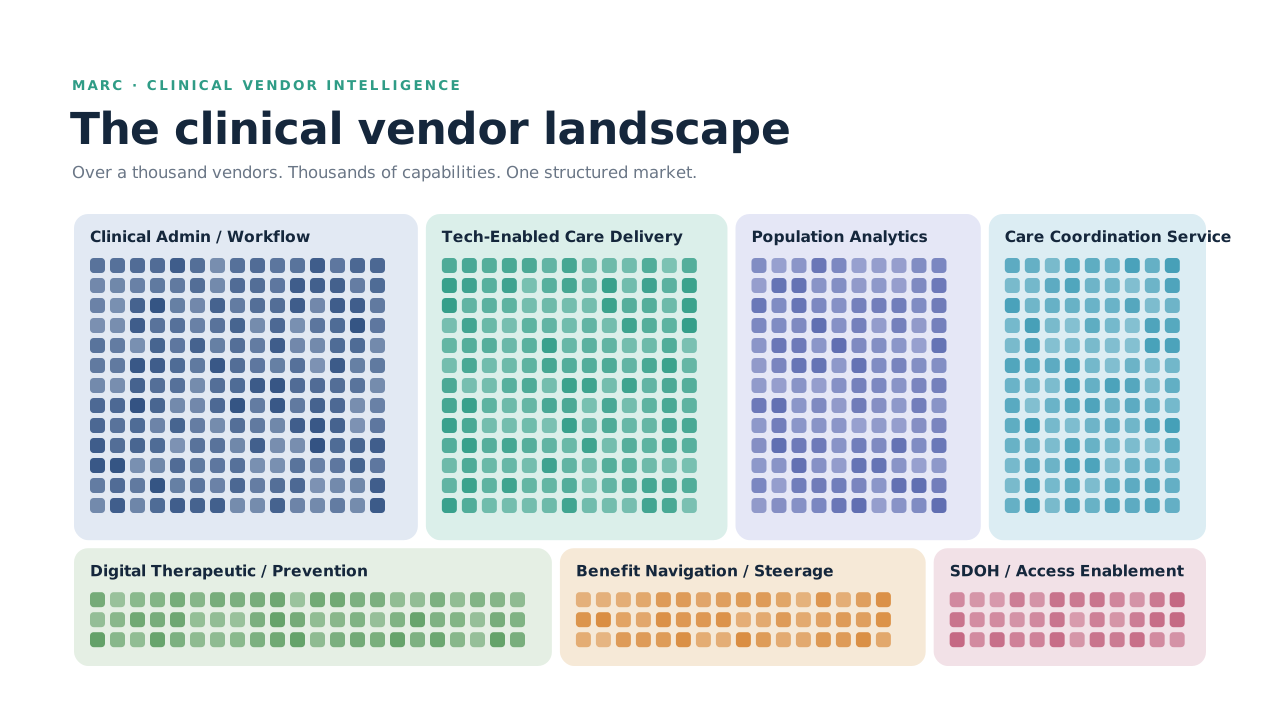
So instead of stopping at the company level, we break each qualified vendor down into its individual capabilities. To date, that has surfaced roughly 2,300 distinct capabilities across about 1,100 companies. We developed a set of eight archetypes to capture how these business models actually work, and sorted every capability into one of them.
What the market looks like
Sorting capabilities this way makes the shape of the market visible. A few patterns stand out:
- Saturated with software. The market is saturated, and the single largest archetype is clinical and administrative workflow software, much of it tooling that does not directly serve patients or members.
- The buzz is small. Categories that dominate headlines, such as digital therapeutics and social drivers of health, are a relatively modest share of what we found in the market.
- Labels blur. Nearly 40% of capabilities show a meaningful second archetype. Real products rarely sit in one neat box.
A market you can actually see is a market you can navigate.
Why this matters
By insisting on a wide net, a high bar, and capability-level classification, we are turning a noisy, hard-to-compare landscape into something structured and queryable, where it is possible to ask precise questions and get answers grounded in evidence rather than marketing.
This is an early look at an ongoing effort. The net keeps widening and the catalog keeps deepening, and we will keep sharing what it reveals.
Get in touch
Want to dig in?
If you'd like to explore what this means for your market or your book of business, we'd love to talk.
More from the library